Literature often reveals truths that public conversation avoids. Some writers choose realism to confront society, although others rely on symbolism, irony, and wit to expose corruption, vanity, and unquestioning loyalty. Among the oldest literary traditions connected to cultural criticism is Satirical Poetry, a form of writing that challenges power through sharp observation and imaginative language. In recent years, satire has regained strong relevance. Political conflict dominates headlines, public debate grows increasingly hostile, and digital culture rewards spectacle more than reflection. Readers seeking meaningful literature are now turning to works that question public behavior rather than entertain audiences. Poetry rooted in satire continues attracting attention because it examines society with clarity and intelligence.
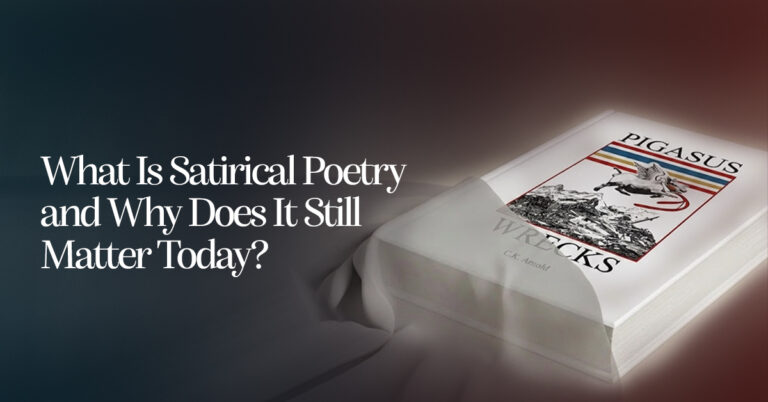
One modern collection that strongly reflects this tradition is Pigasus Wrecks by Roland Caissie. The book combines allegory, symbolism, lyrical writing, and political commentary to examine manipulation, tribal thinking, misinformation, and moral collapse. Rather than delivering direct lectures, the poems create symbolic landscapes in which arrogance, greed, and public obsession take grotesque, striking forms.
The strength of satire comes from its ability to expose contradictions without sounding preachy. A symbolic image or ironic line can sometimes reveal more about society than pages of analysis. That timeless quality explains why satirical writing still matters in modern culture.
The Literary Roots of Satirical Poetry
For centuries, Satirical Poetry has been used to criticize governments, religious hypocrisy, greed, war, and public ignorance. Ancient poets mocked rulers who abused authority, although later writers challenged aristocrats, corrupt institutions, and social inequality through symbolic language and biting humor.
Unlike straightforward criticism, satire transforms difficult subjects into artistic experiences. Exaggeration, irony, and metaphor allow writers to reveal flaws in ways that remain compelling long after the reader finishes the work. Satirical poetry does not simply attack people or systems. It exposes the absurdity hidden beneath public performance. This literary form survives because human behavior rarely changes. Societies continue struggling with vanity, fear, tribal loyalty, manipulation, and power-driven ambition. Satire remains effective because it captures these patterns in creative and layered ways.
Writers such as Jonathan Swift, Alexander Pope, and George Orwell understood that symbolism could uncover truths more effectively than direct argument. Modern satirical poets continue working within that same tradition, using literature to challenge collective thinking and question public narratives.
Also read : Satirical Poetry Definition and Examples
Pigasus Wrecks and the Collapse of Public Reason
Roland Caissie’s Pigasus Wrecks explores a society consumed by spectacle, division, and blind devotion. The collection examines how public identity becomes tied to political loyalty, even when dishonesty and manipulation are obvious. Across the book, crowds cheer destructive behavior as truth fades beneath performance and outrage. The title itself carries symbolic weight. “Pigasus” transforms the mythical Pegasus into a grotesque figure representing vanity, excess, ego, and corrupted ideals. This image becomes central to the collection’s critique of modern culture. Public figures are portrayed as theatrical caricatures driven by self-worship rather than responsibility or wisdom.
Many poems within the collection focus on how propaganda and repetition influence public thinking. Language becomes distorted. Lies are accepted as facts. Public debate turns chaotic and irrational. Through satire, the book questions how societies willingly surrender critical thinking in exchange for tribal belonging and symbolic identity. Instead of targeting only one political figure or movement, the poems examine larger cultural habits that encourage manipulation and division. This broader perspective gives the collection lasting relevance beyond immediate political events.
The Use Of Political Symbolism In Literature
Symbolism has always played an important role in literature because it allows writers to discuss complicated subjects through metaphor and imagination. The use of political symbolism in literature gives readers space to interpret ideas instead of receiving rigid conclusions.
In Pigasus Wrecks, symbolism recurs throughout the collection. Crowds become raging waves. Leaders transform into grotesque creatures. Public movements resemble collapsing carnivals filled with illusion and noise. These images create a world where cultural instability feels visible and tangible. Symbolic writing often leaves a stronger impact because readers participate in the meaning-making process. A distorted image or recurring metaphor invites interpretation, creating deeper engagement with the text. Rather than simply describing corruption, symbolism allows writers to show its consequences in vivid and compelling ways.
This technique also allows literature to remain relevant across generations. Although specific political references may change over time, the larger themes of power, greed, fear, and manipulation recur throughout history.
Why Satire Still Connects With Modern Readers
Modern audiences live in a world flooded with information. News cycles move rapidly, outrage spreads instantly online, and public attention shifts constantly from one controversy to another. In this environment, meaningful reflection often gets lost in noise and repetition.
Satire remains important because it slows readers down and forces them to observe more closely. Instead of accepting public narratives at face value, satire encourages skepticism and independent thinking. It reveals contradictions hidden beneath performance and exposes how language can be manipulated for power and control. Many contemporary readers are drawn to literature that critically examines society while still offering artistic depth. Satirical poetry fulfills that role by combining layered symbolism with cultural critique. Rather than offering easy answers, it invites readers to confront uncertainty and contradiction.
Pigasus Wrecks captures this atmosphere particularly well. The collection portrays modern politics as theater shaped by ego, spectacle, misinformation, and public obsession. The poems repeatedly suggest that people become vulnerable when identity matters more than truth and public image replaces accountability. This tension gives the collection intellectual depth beyond ordinary commentary. The poems ask difficult questions about loyalty, morality, and collective responsibility without simplifying the issues involved.
Also read : What is Satirical Poetry
The Strength of Thought-Provoking Poetry
The strongest literature leaves readers unsettled long after the final page. Thought-provoking poetry achieves this by asking difficult questions rather than offering comfortable conclusions. It challenges assumptions and encourages reflection about society, belief, and personal responsibility.
Pigasus Wrecks succeeds because it balances political criticism with philosophical depth. Alongside the sharper satirical poems are quieter reflections on mortality, environmental decay, loneliness, and uncertainty. These moments create contrast within the collection, preventing the work from becoming repetitive or predictable. Several poems explore the fragility of civilization itself. Public discourse appears unstable, truth becomes negotiable, and violence begins replacing reason. Yet beneath the political critique lies a deeper concern about human nature and the repeated failures of history.
The collection also reflects anxiety surrounding environmental destruction and cultural decline. Landscapes collapse beneath greed and carelessness, as public life becomes increasingly disconnected from wisdom or accountability. These themes broaden the work’s scope and add greater literary richness.
Poetry capable of provoking reflection often survives far longer than temporary political commentary. Readers return to symbolic works because they continue discovering new meanings over time. That layered quality is one reason satire remains influential across generations.
Media Culture and Public Spectacle
One of the most striking elements within Pigasus Wrecks is its portrayal of media culture. Public life no longer revolves around thoughtful debate or careful discussion. Instead, politics becomes performance shaped by branding, outrage, and constant visibility.
The poems describe a culture where spectacle replaces substance. Public figures are celebrated not for wisdom or leadership but for attention-grabbing behavior. Crowds respond more strongly to slogans and conflict than to careful reasoning. Information spreads rapidly, yet understanding becomes increasingly rare. Roland Caissie captures this environment through exaggerated imagery and sharp irony. Public movements resemble chaotic carnivals filled with illusion and noise. Leaders appear larger than life yet hollow beneath the performance. Social conflict turns theatrical and repetitive.
These themes feel particularly relevant in the digital era, where social media platforms reward speed, outrage, and polarization. Public conversations often become shallow and reaction-driven, leaving little room for complexity or nuance. Satire exposes these patterns by pushing them to grotesque extremes. Through symbolic exaggeration, Pigasus Wrecks reveals how easily modern societies can become consumed by distraction and manipulation. The collection suggests that spectacle itself can become a form of control.
Naive Loyalty and Cultural Division
A recurring idea across Pigasus Wrecks involves naive loyalty and collective thinking. The poems repeatedly question why people continue to support systems or leaders who openly contradict their stated values. Crowds appear trapped by identity and resentment, unable or unwilling to confront uncomfortable truths.
This theme gives the collection psychological depth. The poems are not only criticizing politicians or institutions. They are examining the public desire for certainty, belonging, and symbolic identity. Fear and tribal thinking shape perception in ways that weaken independent judgment. The collection suggests that division becomes dangerous when disagreement turns into dehumanization. Opposing viewpoints are dismissed not through discussion but through hostility and mockery. Public identity becomes more important than accountability or truth.
Satire works especially well in this context because it exposes irrational behavior without relying on direct lectures. By exaggerating public devotion and collective absurdity, the poems force readers to recognize patterns that might otherwise go unnoticed in everyday culture. This focus on human behavior gives the collection broader meaning beyond specific political events. The poems explore recurring weaknesses that continue shaping societies throughout history.
Mortality and Existential Reflection
Although the collection contains sharp political critique, it also spends significant time reflecting on mortality and existence. Several poems step away from public conflict and focus instead on impermanence, aging, and the uncertainty surrounding human life.
Nature imagery appears frequently across the book. Oceans, storms, deserts, and shifting skies create moments of quiet reflection amid the harsher satire. These passages remind readers that political conflict exists within a larger and indifferent universe. Some poems confront death directly, questioning ideas of salvation and permanence. Others focus on the fleeting nature of power and public identity. Leaders who appear dominant eventually fade, as civilizations built on arrogance and greed collapse beneath their own contradictions.
These existential themes add complexity to the collection. The poems become more than political criticism. They transform into reflections on fear, meaning, memory, and human limitation. This broader perspective strengthens the literary quality of Pigasus Wrecks. The work examines not only public behavior but also the deeper anxieties that shape civilization itself.
Why Satirical Writing Continues to Matter
As long as societies struggle with corruption, manipulation, greed, and tribal division, satire will remain necessary. Political systems may evolve, technology may change, and public culture may shift, yet human weakness continues to repeat across generations. Satirical literature survives because it exposes these patterns with clarity and imagination. Humor, irony, and symbolism allow writers to criticize society without sounding mechanical or predictable. A carefully crafted metaphor can reveal cultural truths more effectively than endless debate.
Modern culture especially needs literature that encourages reflection rather than instant reaction. Public discourse often rewards certainty and outrage while discouraging complexity. Satire interrupts this pattern by exposing contradictions and questioning collective assumptions.
Pigasus Wrecks by Roland Caissie demonstrates how modern satire can remain artistically rich while addressing urgent cultural realities. The collection blends allegory, symbolism, philosophical reflection, and sharp political commentary into a work that feels both contemporary and timeless. More importantly, the book reminds readers that satire is not merely about ridicule. At its best, satire challenges complacency and encourages self-awareness. It asks readers to question authority, examine public behavior, and recognize how easily truth becomes distorted within systems built on spectacle and division.